
- Home
- IEC 60947 Circuit Breaker Standard: Complete Compliance Guide
IEC 60947 Circuit Breaker Standard: Complete Compliance Guide
Understanding the IEC 60947 circuit breaker standard framework is vital for electrical project managers, panel builders, and B2B component importers. As low-voltage power distribution systems grow more complex, ensuring that miniature circuit breakers (MCBs), molded case circuit breakers (MCCBs), and air circuit breakers (ACBs) comply with international safety benchmarks prevents costly project delays and equipment failures.
Published by the International Electrotechnical Commission, the IEC 60947 series defines performance, safety, and testing methodologies for low-voltage switchgear worldwide. This guide covers the structure of the standard, key differences between industrial and residential compliance, and critical factory quality testing required for international distribution.
Key Compliance Takeaways
Industrial Application Scope: IEC 60947-2 is the definitive standard governing low-voltage circuit breakers intended for industrial and commercial environments operated by trained personnel.
Icu vs. Ics Parameters: Compliance requires verifying both Ultimate Short-Circuit Breaking Capacity (Icu) and Service Short-Circuit Breaking Capacity (Ics) to guarantee operational safety after a fault event.
IEC 60947 vs. IEC 60898: Industrial breakers tested under IEC 60947-2 undergo significantly more rigorous thermal and short-circuit testing compared to household breakers under IEC 60898-1.
Understanding the IEC 60947 Standard Family
The IEC 60947 standard series covers low-voltage switchgear and controlgear operating up to 1,000 V AC or 1,500 V DC. To specify components accurately, engineers must understand how its sub-parts interact.
IEC 60947 Series
Part 1: General Rules (Ui, Uimp, Environmental & Thermal Limits)
Part 2: Circuit Breakers (Industrial MCB / MCCB / ACB Standards)
IEC 60947-1: General Rules
Part 1 sets the foundational baseline for all low-voltage switchgear. It establishes common definitions, rated insulation voltages Ui, impulse withstand voltages Uimp, and enclosure IP protection requirements used across all subordinate parts.
IEC 60947-2: Circuit Breakers
Part 2 specifically applies to circuit breakers whose main contacts are intended to be connected to circuits with rated voltages not exceeding 1,000 V AC. It outlines strict requirements for:
Overload protection characteristics (thermal-magnetic and electronic trip units).
Short-circuit breaking and making capacities under extreme electromagnetic stress.
Isolation suitability for safe down-line maintenance.
IEC 60947-2 vs. IEC 60898-1: What's the Difference?
A common confusion among B2B buyers is distinguishing between the IEC 60947 circuit breaker standard (Part 2) and the household standard IEC 60898-1. Using residential-grade breakers in industrial applications can lead to severe safety non-compliance.
| Comparison Metric | IEC 60947-2 (Industrial) | IEC 60898-1 (Residential) |
|---|---|---|
| Intended User | Qualified electrical personnel | Unskilled / household users |
| Operating Environment | Industrial plants, data centers, heavy commercial | Residential homes, small retail shops |
| Breaking Capacity Ratings | Defined by $I_{cu}$ and $I_{cs}$ (up to 100 kA+) | Defined by $I_{cn}$ (typically 4.5 kA to 10 kA) |
| Calibration Temperature | Standard calibrated at $30^\circ\text{C}$ or $40^\circ\text{C}$ | Standard calibrated strictly at $30^\circ\text{C}$ |
| Trip Characteristics | Customizable electronic / adjustable magnetic | Fixed instantaneous curves (B, C, D) |
Critical Quality Tests Under the IEC 60947 Circuit Breaker Standard
To earn CE certification and pass international project audits, manufacturers must subject breakers to rigorous lab testing:
1. Temperature Rise and Power Loss Test
Breakers carry 100% rated continuous current until thermal equilibrium is reached. Terminal temperature rises must not exceed strict limits (e.g., 60K or 70K depending on terminal insulation) to prevent busbar degradation.
2. Short-Circuit Breaking Capacity Test Icu and Ics
Ultimate Breaking Capacity Icu: The maximum short-circuit current the breaker can clear twice without causing dangerous arc flash or explosive failure.
Service Breaking Capacity Ics: The short-circuit current the breaker can clear repeatedly while remaining fully operational for continuous service afterwards.
3. Dielectric Withstand & Isolation Testing
Ensures the main contacts provide safe electrical isolation when opened. High voltage impulses are applied across open contacts to prove that flashover will not occur during lightning or switching surges.
For information on how circuit breakers integrate into dual power transfer systems, read our guide on PC Class vs CB Class ATS: Complete Selection Guide.
Why Compliance Matters for B2B Importers and Panel Builders
Importing circuit breakers verified against the IEC 60947 circuit breaker standard protects your business and client investments:
Smooth Customs Clearance: Overseas markets require third-party test reports (from bodies like DEKRA, TÜV, or CB scheme labs) matching CE declarations.
Reduced Liability: Installing certified breakers eliminates legal and financial liabilities associated with electrical fires or industrial downtime.
Seamless Engineering Tender Eligibility: Government and utility engineering tenders explicitly require IEC 60947-2 certified low-voltage components.
Review full international testing guidelines on the official International Electrotechnical Commission Repository.
Frequently Asked Questions (FAQ)
Q1: What is the difference between Icu and Ics under the IEC 60947 circuit breaker standard?
Icu (Ultimate Short-Circuit Breaking Capacity) measures the absolute maximum fault current a breaker can clear safely, though the breaker may need replacement afterwards. Ics (Service Short-Circuit Breaking Capacity) measures the fault level the breaker can clear while maintaining full functional integrity for continued operation. Ics is usually expressed as a percentage (50%, 75%, or 100%) of Icu.
Q2: Can an IEC 60898 certified breaker be installed in industrial panels?
While an IEC 60898 breaker may work physically, it is generally not recommended for industrial main panels. Industrial environments feature higher prospective short-circuit currents and elevated ambient temperatures that require the higher breaking capacities Icu and thermal flexibility mandated by IEC 60947-2.
Q3: How do CE marking and IEC 60947 compliance relate?
The CE mark is a manufacturer’s self-declaration of conformity to European safety, health, and environmental protection standards. For low-voltage switchgear, demonstrating compliance with the harmonized EN/IEC 60947 standards provides the technical evidence required to legally affix the CE mark.
Conclusion & Engineering Support
Adhering to the IEC 60947 circuit breaker standard guarantees that low-voltage components deliver robust overcurrent protection, high short-circuit withstand capabilities, and long-term operating safety. Partnering with a source manufacturer that enforces strict IEC testing protocols ensures your projects meet global engineering criteria.
Need CE & IEC Certified Circuit Breakers for Your Projects?
Zhejiang Manfu Power Technology Co., Ltd. manufactures certified MCBs, MCCBs, and ACBs tailored for global distributors, panel builders, and OEM partners.
Explore Products: Browse our full line of Industrial Circuit Breakers.
Request Certification Docs: Contact our engineering sales team for third-party test reports, CAD drawings, and direct factory pricing.
Get In Touch
Partner with a Trusted Electrical Manufacturer
Looking for high-reliability electrical components, OEM/ODM solutions, or custom bulk pricing? Our engineering team is ready to support your project requirements.
Direct Call
+86 (566) 456-7890
Email Inquiry
support@zjmnfu.com
Request a Fast & Free Quote
Fill out the form below and our sales team will respond with product specifications and pricing within 24 hours.
Other Related Blogs
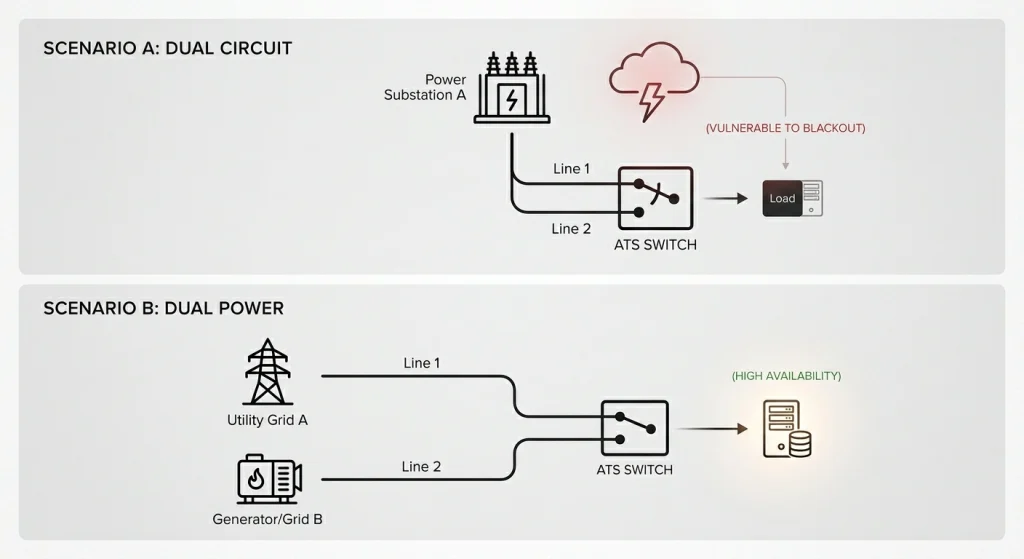
- Product Knowledge, 未分类
Dual Power Supply vs Dual Circuit: What is the difference?
Home Dual Power vs Dual Circuit ATS: Clear Engineering Differences If you ask…
- Product Knowledge, 未分类
Industrial Circuit Breaker Tripping Causes: Fixes & Prevention Guide
Home Industrial Circuit Breaker Tripping Causes: Field Troubleshooting & Fixes Understanding industrial circuit…
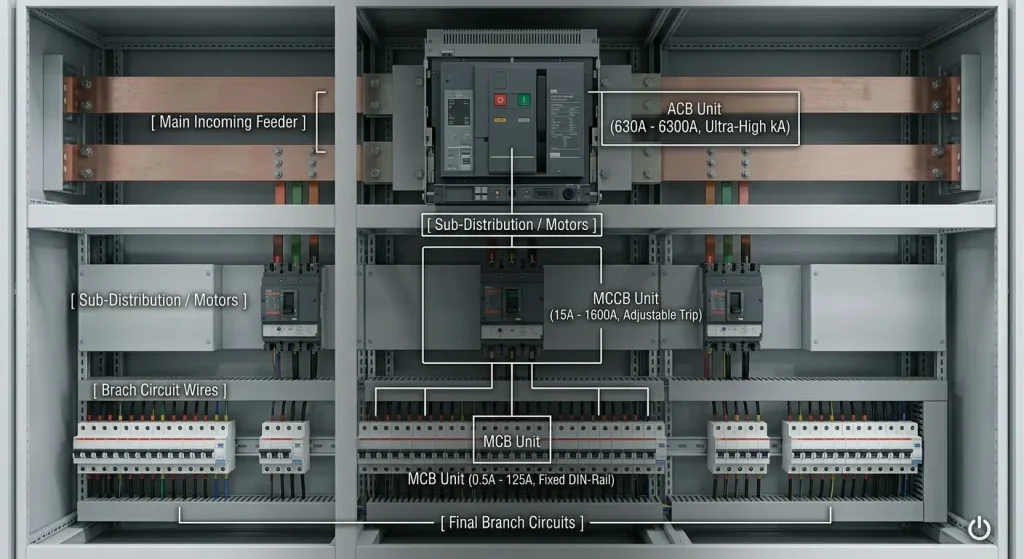
- Product Knowledge, 未分类
Difference Between MCB MCCB and ACB: Complete Selection Guide
Home Difference Between MCB MCCB and ACB: Complete Selection Guide Navigating the difference…
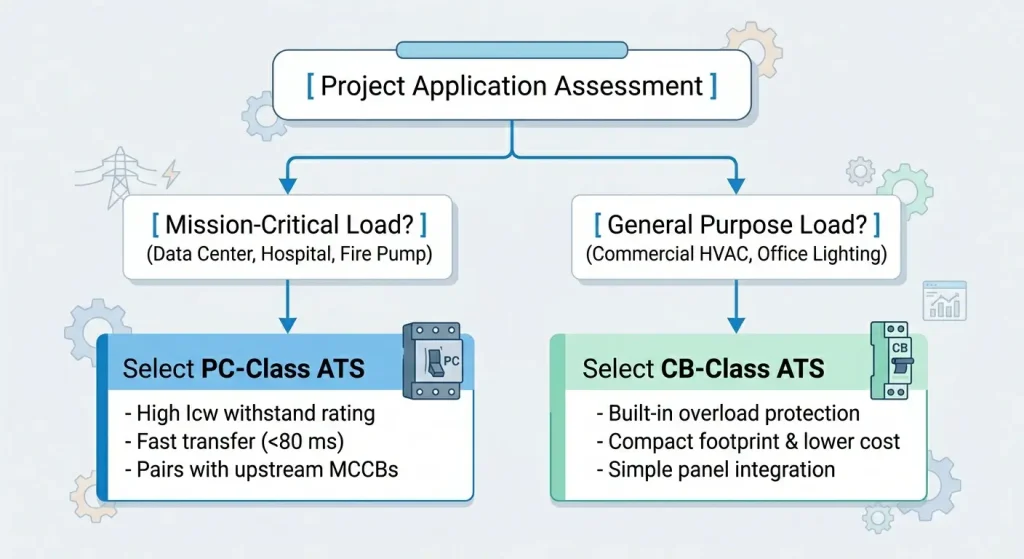
- Product Knowledge
PC Class vs CB Class ATS: How to Choose the Right Automatic Transfer Switch
Home PC Class vs CB Class Automatic Transfer Switch: How to Choose the…

- Product Knowledge
Emergency Power Transfer Switch: Complete Guide for Hospitals & Data Centers
Home Emergency Power Transfer Switch: Complete Guide for Hospitals & Data Centers Deploying…