
- Home
- Dual Power Supply vs Dual Circuit: What is the difference?
Dual Power vs Dual Circuit ATS: Clear Engineering Differences
If you ask ten electrical designers about the exact boundary between dual power vs dual circuit ATS configurations, you will likely get ten slightly different answers. In day-to-day conversation, engineers and procurement officers often treat “dual power,” “dual circuit,” and “redundant power supply” as interchangeable marketing jargon.
However, in technical auditing, international tender compliance, and emergency switchgear design, a single misplaced term can compromise your entire facility’s reliability model—or lead to immediate rejection during safety inspections.
Whether you are designing a high-tier data center, a regional hospital emergency system, or a heavy industrial distribution board, this guide dismantles the confusion around dual source architectures and explains how to select the right automatic transfer switchgear for complete power availability.
The Root of the Confusion: Circuit vs. Source Redundancy
To build a zero-downtime power system, you must first separate physical wire routing from ultimate power independence.
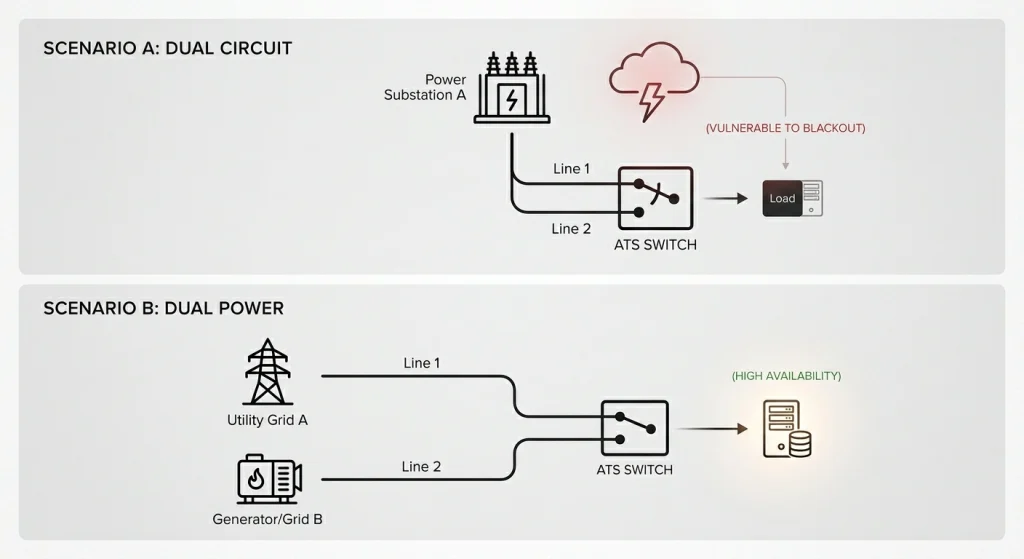
1. Dual Circuit Power Supply (Double Feeder Lines)
A dual circuit setup refers to pulling two separate physical wiring lines to a single load or transfer switch.
The Caveat: These two circuits frequently originate from the same upstream transformer, the same substation, or the same utility busbar.
The Risk: While dual circuits protect against localized cable damage (such as physical trench rupture or wire overheating), they offer zero protection if the upstream substation experiences a main transformer failure or grid blackout.
2. Dual Power Supply (Independent Energy Sources)
A true dual power system derives electricity from two completely isolated power sources—for instance, two independent municipal substations, or one main utility grid combined with an onsite diesel generator / battery storage system.
The Goal: The correlation between Source A and Source B is practically zero. If Utility Grid A collapses entirely, Backup Source B continues feeding power uninterrupted via an Automatic Transfer Switch (ATS).
Decoding International Compliance: What Standards Actually Say
When submitting panel engineering designs to regional utility authorities, terminology aligns with strict standard definitions. Comparing global frameworks reveals how redundancy is enforced:
| Standards Framework | Key Terminology | Grid Isolation Criteria | Typical ATS Switchgear Requirement |
|---|---|---|---|
| IEC 60947-6-1 / EN | Transfer Switching Equipment (TSE) | Mandates complete isolation between main and secondary utility inputs. | PC-Class high-speed transfer switches with Icw short-time withstand. |
| GB 50052 / GB 29328 | Dual Power (双电源) / Dual Circuit (双回路) | Dual Power requires independent substations; Dual Circuit permits shared busbars. | Automatic Transfer Switches with electrical and mechanical interlocks. |
| NFPA 110 / IEEE 446 | Emergency Power Supply Systems (EPSS) | Demands physically separated emergency sources capable of taking load in <10s. | Heavy-duty bypass isolation ATS or PC-class switches. |
The “Absolute Independence” Myth in Modern Grids
In large regional utility networks, complete electrical independence is a theoretical ideal. Because major power grids are interconnected at high-voltage transmission levels, even power drawn from separate regional substations shares a common upstream grid connection at some point.
For critical facilities (such as intensive care units, semiconductor plants, and data centers), true dual-power isolation is achieved by pairing one utility grid line with one dedicated, onsite emergency diesel generator or UPS storage system.
Evaluating Dual Power vs Dual Circuit ATS Architecture
To determine which switchgear configuration fits your project budget and reliability requirements, evaluate your system against these three engineering criteria:
Project Risk Assessment
Critical Load / High Loss
– Requires Dual Power ATS
– Independent Grid + Generator
– Fast PC-Class Mechanism (<80ms)
General Industrial Load
– Accepts Dual Circuit ATS
– Single Substation / Dual Line
– Standard CB-Class or PC-Class
Criterion 1: Switching Dynamics and Contact Speed
In a dual circuit system, switching usually occurs during planned maintenance or cable failure. However, in a true dual power ATS application, the switch must handle sudden, unannounced grid collapse. Selecting a fast, solenoid-driven PC-Class ATS ensures contact transfer occurs in 30ms to 80ms, preventing sensitive PLCs and control relays from dropping out during grid transitions.
Criterion 2: Short-Circuit Fault Isolation
If a short circuit occurs downstream, a dual-power transfer switch must withstand high electrodynamic forces without contact welding while upstream protective devices clear the fault. Ensure your ATS switchgear carries a high Short-Time Withstand Current (Icw) rating tested under IEC 60947-6-1 guidelines.
For a deep dive into internal switch architectures, read our technical breakdown on PC Class vs CB Class ATS: Complete Selection Guide.
Practical Checklist for Switchgear OEM Importers and Engineers
When sourcing transfer switches for dual-source distribution boxes, verify these key build factors with your switchboard factory:
Mechanical & Electrical Interlocking: Dual-source switches must feature absolute mechanical interlocks to prevent simultaneous closure onto two unsynchronized power lines, which can cause catastrophic short-circuit phase explosions.
Phase Failure & Voltage Sensing: Ensure the integrated ATS controller actively monitors phase loss, undervoltage, and frequency drift on both incoming lines before signaling a switchover.
Factory Testing Documentation: Review third-party test reports for temperature rise limits and short-circuit withstand capabilities. Explore test guidelines on the official International Electrotechnical Commission Repository.
Engineering FAQs
Q1: Is a dual circuit system sufficient for a hospital emergency line?
No. Standard hospital codes (such as NFPA 110 or GB 50052 Class I loads) mandate true dual power configurations. Emergency life-support feeders must be backed up by an onsite emergency diesel generator or dedicated energy storage system, not merely a second feeder cable from the same municipal transformer.
Q2: What is the main structural difference in a dual power vs dual circuit ATS installation?
A dual-circuit installation typically connects two incoming line breakers from adjacent panel sections. A dual power ATS installation connects two completely separate power pathways (such as Utility Main vs Generator Incomer), often requiring automatic generator start/stop control signal wiring integrated into the ATS logic board.
Q3: Can a single ATS unit manage dual power switching between a grid and a generator?
Yes. Modern dual-power Automatic Transfer Switches feature integrated engine-start contact outputs. When Utility Source A fails, the ATS controller signals the backup diesel generator to start, monitors generator voltage stabilization, and then automatically transfers the load to Source B.
Final Engineering Recommendations
Understanding the real-world boundaries of dual power vs dual circuit ATS applications ensures that electrical designs deliver true system redundancy rather than illusory safety.
Need Certified Automatic Transfer Switches for Your OEM Projects?
Zhejiang Manfu Power Technology Co., Ltd. manufactures industrial-grade PC-Class and CB-Class Automatic Transfer Switches engineered for global switchboard builders, project contractors, and electrical importers.
Explore Product Lines: Check out our complete range of Automatic Transfer Switches (ATS).
Technical Consultation: Contact our engineering team for CAD wiring schematics, third-party test documentation, and direct factory pricing.
Get In Touch
Partner with a Trusted Electrical Manufacturer
Looking for high-reliability electrical components, OEM/ODM solutions, or custom bulk pricing? Our engineering team is ready to support your project requirements.
Direct Call
+86 (566) 456-7890
Email Inquiry
support@zjmnfu.com
Request a Fast & Free Quote
Fill out the form below and our sales team will respond with product specifications and pricing within 24 hours.
Other Related Blogs
- Product Knowledge, 未分类
Industrial Circuit Breaker Tripping Causes: Fixes & Prevention Guide
Home Industrial Circuit Breaker Tripping Causes: Field Troubleshooting & Fixes Understanding industrial circuit…
- Product Knowledge, 未分类
Difference Between MCB MCCB and ACB: Complete Selection Guide
Home Difference Between MCB MCCB and ACB: Complete Selection Guide Navigating the difference…
- Product Knowledge
PC Class vs CB Class ATS: How to Choose the Right Automatic Transfer Switch
Home PC Class vs CB Class Automatic Transfer Switch: How to Choose the…