
- Home
- Emergency Power Transfer Switch: Complete Guide for Hospitals & Data Centers
Emergency Power Transfer Switch: Complete Guide for Hospitals & Data Centers
Deploying a reliable emergency power transfer switch is the cornerstone of electrical infrastructure in mission-critical facilities. In environments like hospitals, data centers, and automated manufacturing plants, even a momentary drop in primary utility power can trigger life-threatening equipment shutdowns or catastrophic data corruption.
An automatic transfer switch (ATS) acts as the intelligent controller and switching muscle between the main utility grid and an auxiliary generator or uninterruptible power supply (UPS). This guide explores the technical requirements, switching speeds, and selection criteria for specifying an emergency power transfer switch in zero-downtime applications.
Executive Summary for Engineering Teams
Healthcare Compliance: Hospitals require rapid transfer switches that can restore power to essential electrical systems within 10 seconds (as mandated by standards like NFPA 110 and IEC 60947-6-1).
Data Center Redundancy: Tier III and Tier IV data centers demand high short-time withstand current (Icw) ratings and fast transfer times (<80 ms) to prevent server resets and transformer saturation.
Switch Class Selection: PC-class transfer switches are strongly recommended for main emergency feeders due to their high fault withstand capability and lack of thermal-magnetic trip mechanisms.
Why Hospitals & Data Centers Need a Specialized Emergency Power Transfer Switch
Power reliability in critical infrastructure is not merely about convenience—it is tied directly to operational safety and financial risk mitigation. Standard commercial distribution boxes are insufficient for these environments.
[ Main Utility Grid ] ───┐
                         ├──> [ Emergency Power Transfer Switch ] ───> [ Critical Load ]
[ Backup Generator ]  ───┘       (Fast Transfer & High Icw)           (ICU / Server Racks)
Life Safety Hazards in Healthcare Facilities
In operating theaters, intensive care units (ICUs), and isolation wards, life-support equipment, surgical lighting, and positive-pressure ventilation systems depend on continuous power. An emergency power transfer switch must detect grid phase loss or voltage drop instantly, send a signal to start the backup diesel generator, and transition the load smoothly without causing nuisance tripping on upstream circuits.
Financial and Operational Losses in Data Infrastructure
Modern data centers house high-density server racks and cloud computing hardware. A power interruption lasting as little as 20 milliseconds can cause server power supply units (PSUs) to drop out, resulting in uncommitted transaction loss, hardware damage, and millions of dollars in downtime penalties.
4 Technical Requirements for Critical Emergency Power Systems
When specifying an emergency power transfer switch for high-availability facilities, engineers must evaluate four non-negotiable technical metrics:
1. Ultra-Fast Transfer Duration (<80 ms)
The total transfer time includes fault detection delay, mechanism operating time, and arc extinguishment. Solenoid-driven PC-class switches achieve transfer durations as fast as 30 ms to 80 ms, minimizing voltage sag on downstream sensitive electronics.
2. High Short-Time Withstand Current (Icw)
During a downstream short-circuit fault, a high fault current flows through the transfer switch until the branch breaker opens. The transfer switch contacts must withstand high electrodynamic forces without welding or burning. High Icw ratings ensure the switch remains operational after fault clearance.
3. Bypass Isolation Capability
For 24/7 facilities where power cannot be interrupted even for maintenance, a bypass isolation transfer switch allows technicians to manually bypass electrical power directly to the load while isolating the main ATS unit for inspection, testing, or maintenance.
4. Smart Controller & Communication Interfaces
Modern critical switches integrate RS485 or Ethernet communication modules supporting Modbus-RTU protocols. This allows facility management systems (FMS) to monitor source voltage, frequency, phase balance, and contact status in real time.
PC-Class vs CB-Class: Application Matrix
Selecting the right switch class depends on where the unit sits within the electrical distribution tree:
| Facility Application | Recommended Switch Class | Required Transfer Speed | Primary Selection Factor |
|---|---|---|---|
| Hospital Main Emergency Feeder | PC-Class ATS | <80 ms | High Icw withstand rating, no self-tripping |
| Data Center Main Distribution | PC-Class ATS | <50 ms | High contact durability, fast transition |
| Commercial HVAC & Lighting | CB-Class ATS | 100 ms - 300 ms | Integrated overload protection, lower cost |
| Emergency Fire Pump Line | PC-Class ATS | <100 ms | Uncompromised short-circuit withstand |
For a deep dive into internal switch architectures, read our technical guide on PC Class vs CB Class ATS: Complete Selection Guide.
Quality Testing and Compliance Standards
To guarantee operational performance during emergency utility outages, switches installed in critical infrastructure must meet established global standards:
IEC 60947-6-1 Compliance: Ensures the transfer equipment meets international criteria for operational capability, temperature rise limits, and short-circuit withstand performance. Refer to the official IEC Standards Repository for full compliance parameters.
Thermal Imaging & Contact Resistance Tests: High-current emergency switching units should maintain stable temperature profiles during prolonged full-load operation inside IP54 or IP65 enclosures.
Endurance Cycle Verification: Industrial-grade emergency transfer equipment should undergo at least 10,000 mechanical and electrical test cycles to prevent contact jamming or actuator failure.
Frequently Asked Questions (FAQ)
Q1: How fast must an emergency power transfer switch operate in a hospital?
Healthcare codes (such as NFPA 110 Class 10 standards) mandate that emergency generators and automatic transfer switches must restore power to life-safety branch circuits within 10 seconds of primary power failure. The switch mechanism itself typically operates within 50 ms to 100 ms once generator power stabilizes.
Q2: What is the difference between open transition and closed transition ATS?
An open transition switch (“break-before-make”) momentarily disconnects the load from the main source before connecting to the backup source, causing a brief millisecond interruption. A closed transition switch (“make-before-break”) briefly parallels both sources for less than 100 milliseconds to achieve zero-interruption transfer during planned testing or grid restoration.
Q3: Can I use a CB-class switch as an emergency power transfer switch for generator systems?
Yes, CB-class switches can be used for standard commercial buildings, HVAC systems, or non-critical industrial distribution boards where integrated overcurrent protection helps save space and panel building costs. However, for critical healthcare or data center feeders, PC-class switches are preferred to prevent nuisance tripping during minor power disturbances.
Conclusion & Factory OEM Support
Installing a high-performance emergency power transfer switch is essential for safeguarding healthcare facilities, data centers, and critical industrial operations from unprogrammed downtime. By specifying switches with rapid transfer speeds, high Icw ratings, and robust contact design, engineers can ensure complete power continuity when the main grid fails.
Need Custom Engineering Specs or Factory Quotations?
Zhejiang Manfu Power Technology Co., Ltd. manufactures certified PC-Class and CB-Class Automatic Transfer Switches engineered for global B2B buyers, panel builders, and OEM partners.
Explore Products: View our complete line of Automatic Transfer Switches (ATS).
Technical Consultation: Contact our engineering team for CAD schematics, customized enclosure options, and factory-direct pricing.
Get In Touch
Partner with a Trusted Electrical Manufacturer
Looking for high-reliability electrical components, OEM/ODM solutions, or custom bulk pricing? Our engineering team is ready to support your project requirements.
Direct Call
+86 (566) 456-7890
Email Inquiry
support@zjmnfu.com
Request a Fast & Free Quote
Fill out the form below and our sales team will respond with product specifications and pricing within 24 hours.
Other Related Blogs
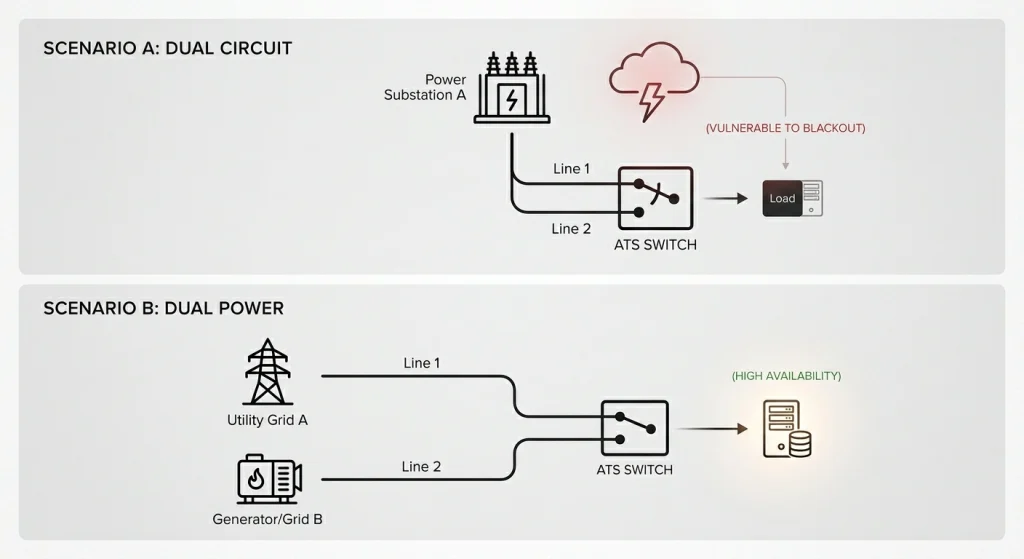
- Product Knowledge, 未分类
Dual Power Supply vs Dual Circuit: What is the difference?
Home Dual Power vs Dual Circuit ATS: Clear Engineering Differences If you ask…
- Product Knowledge, 未分类
Industrial Circuit Breaker Tripping Causes: Fixes & Prevention Guide
Home Industrial Circuit Breaker Tripping Causes: Field Troubleshooting & Fixes Understanding industrial circuit…
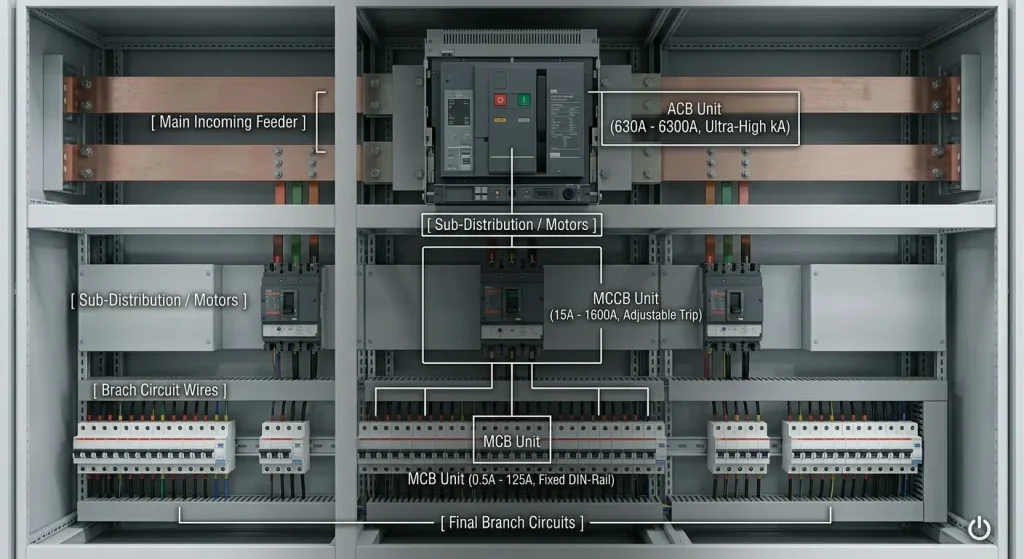
- Product Knowledge, 未分类
Difference Between MCB MCCB and ACB: Complete Selection Guide
Home Difference Between MCB MCCB and ACB: Complete Selection Guide Navigating the difference…
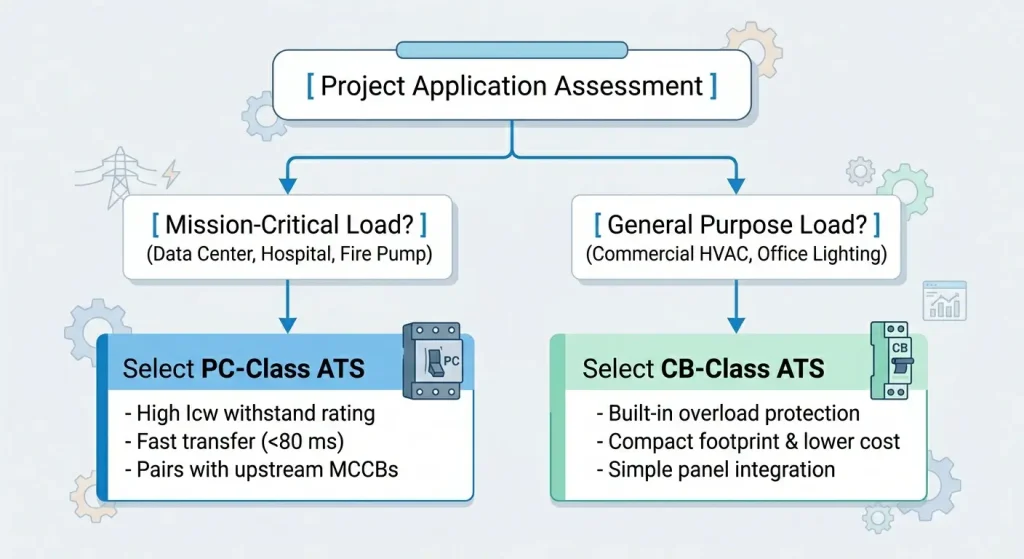
- Product Knowledge
PC Class vs CB Class ATS: How to Choose the Right Automatic Transfer Switch
Home PC Class vs CB Class Automatic Transfer Switch: How to Choose the…

- Product Knowledge
IEC 60947 Circuit Breaker Standard: Complete Compliance Guide
Home IEC 60947 Circuit Breaker Standard: Complete Compliance Guide Understanding the IEC 60947…