
- Home
- Industrial Circuit Breaker Tripping Causes: Fixes & Prevention Guide
Industrial Circuit Breaker Tripping Causes: Field Troubleshooting & Fixes
Understanding industrial circuit breaker tripping causes is vital for field engineers, plant maintenance teams, and control panel builders. When an industrial molded case circuit breaker (MCCB) or miniature circuit breaker (MCB) trips, it brings production lines, CNC machinery, or HVAC systems to a sudden halt. In high-demand manufacturing environments, every hour of unprogrammed downtime translates directly into significant financial losses.
However, a tripped breaker is not necessarily a sign of a defective switch. Instead, it indicates that the protective device has successfully interrupted an abnormal electrical condition to prevent electrical fires, cable insulation melting, or motor burnout.
This comprehensive field guide covers safe diagnostic protocols, 5 root causes of circuit breaker tripping, and practical design solutions to eliminate nuisance tripping in industrial automation panels.
The First 5 Minutes: Safe Field Inspection Protocol
Before attempting to reset a tripped breaker, maintenance technicians must follow a structured, step-by-step diagnostic workflow. Randomly forcing a breaker back to the “ON” position without identifying the underlying fault can cause catastrophic arc flash accidents if a severe short circuit is still active on the line.
Breaker Trips
- Step 1: Visual & Odor Inspection (Check for smoke, discoloration, or burning smell)
- Step 2: Handle Position Verification (Distinguish ON, OFF, and middle TRIP state)
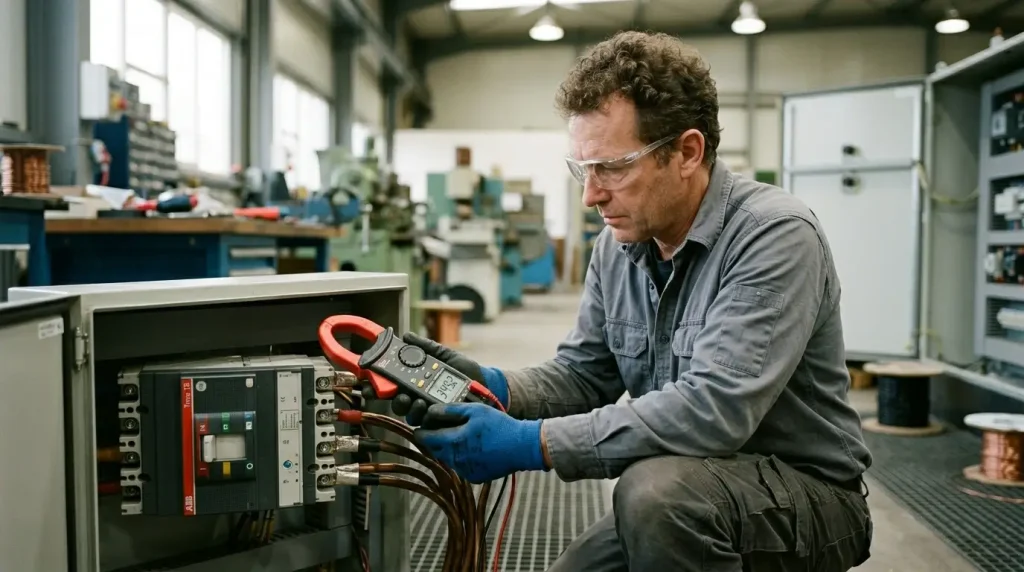
- Step 3: Thermal Camera Scan (Identify loose connection terminals & overheating)
- Step 4: Clamp Meter Measurement (Verify phase current balance & running amps)
1. Visual and Odor Inspection
Inspect the front face of the enclosure and the circuit breaker body. Look for telltale signs of thermal stress: scorched plastic housing, discolored copper busbars, or a pungent smell of burnt wire insulation. If any of these signs are present, do not reset the breaker; isolate the power source immediately.
2. Verify Handle Position
Industrial circuit breakers feature three distinct handle positions: ON, OFF, and TRIP (positioned in the middle). If the handle rests in the center position, the internal trip latch mechanism was triggered by an electrical fault or thermal overload rather than being manually toggled. To reset a tripped breaker, you must push the handle firmly down to the OFF position first to re-engage the trip spring before moving it back to ON.
5 Root Industrial Circuit Breaker Tripping Causes
Identifying the exact origin of a fault requires understanding how different internal trip mechanisms respond to electrical anomalies. Below are the 5 primary industrial circuit breaker tripping causes encountered in automation systems:
[ Industrial Tripping Factors ]
│
┌───────────────────┬──────────────────┼────────────────────┬───────────────────┐
▼ ▼ ▼ ▼ ▼
[ Thermal Overload ] [ Short Circuit ] [ Ground Fault ] [ Harmonics/Inrush ] [ High Ambient Temp ]
Slow, cumulative Instantaneous Moisture/Leak VFD / Large Motors Panel heat buildup
1. Persistent Thermal Overload
Thermal overload is the most common cause of delayed breaker tripping. It occurs when connected equipment draws current slightly above the breaker’s rated current (In) for an extended period.
The Mechanism: Inside a thermal-magnetic breaker, continuous overcurrent causes a internal bimetallic strip to heat up and bend. As it bends, it gradually pushes the mechanical trip bar.
Symptom: The breaker runs fine for 10 to 30 minutes before tripping, especially when multiple motors or heaters operate simultaneously.
2. Instantaneous Short-Circuit Faults
A short circuit occurs when a hot phase wire comes into direct contact with another phase or neutral wire, creating an almost infinite current path with minimal resistance.
The Mechanism: The sudden current spike creates a powerful electromagnetic field inside the breaker’s magnetic trip coil, instantly pulling the trip lever within less than 10 milliseconds.
Symptom: The breaker trips instantaneously upon closing, often accompanied by an audible pop or visible spark inside the arc chute.
3. Ground Faults and Insulation Breakdown
Ground faults occur when electrical current strays from its intended conductor path and flows directly into the grounded metal frame of a machine or enclosure panel.
The Mechanism: Dust accumulation, moisture ingress, or vibration-induced wire chafing degrades cable insulation over time. Ground fault trip units or residual current devices (RCDs) detect this current imbalance between phase and neutral lines and trip the circuit.
4. Nuisance Tripping from Harmonics & Inrush Current
Modern industrial facilities rely heavily on variable frequency drives (VFDs), switching power supplies, and large induction motors.
Motor Inrush Current: Direct-on-line (DOL) motor starting produces transient current surges 6 to 8 times higher than the rated operating current for a few seconds. If an MCB with an incorrect trip curve (e.g., Type B instead of Type D) is installed, starting the motor will trigger immediate tripping.
VFD Harmonics: VFDs generate high-frequency non-linear harmonic currents. These harmonics can cause electronic trip units to misread true RMS current values, leading to unexpected “nuisance tripping” even when the fundamental current is well within safe limits.
5. High Enclosure Ambient Temperatures (Thermal Derating)
Circuit breakers are calibrated under standard laboratory conditions (typically 30°C or 40°C according to IEC standards).
The Mechanism: When breakers are packed tightly inside IP65 sealed enclosures without adequate cabinet ventilation or cooling units, internal temperatures can easily reach 50°C to 60°C. High ambient heat pre-heats the bimetallic strip, causing the breaker to trip at a much lower current than its faceplate rating—a phenomenon known as thermal derating.
Diagnostic Flowchart & Symptom Resolution Matrix
Use the reference matrix below to quickly match tripping symptoms with field diagnostic steps and corrective actions:
| Engineering Parameter | MCB (Miniature) | MCCB (Molded Case) | ACB (Air Circuit Breaker) |
|---|---|---|---|
| Rated Current Range (In) | 1A to 125A | 10A to 1600A | 630A to 6300A |
| Breaking Capacity (Icu) | 4.5kA to 10kA | 10kA to 100kA+ | 50kA to 150kA+ |
| Trip Unit Technology | Fixed thermal-magnetic | Adjustable thermal or electronic | Advanced microprocessor / Micro-logic |
| Mounting Architecture | 35mm DIN-rail snap-on | Panel chassis / Base plate mount | Fixed or Draw-out (Rackable) frame |
| Primary System Role | Terminal circuit protection | Feeder & motor branch protection | Main low-voltage transformer incomer |
For a detailed guide on choosing between different low-voltage breaker frame sizes, read our comparison article on Difference Between MCB MCCB and ACB Demystified: Low-Voltage Guide.
How Panel Builders Prevent Nuisance Tripping at the Design Stage
Preventing unexpected industrial circuit breaker tripping causes begins during panel layout and specification:
Select the Correct Trip Curve: Match the breaker’s magnetic tripping response to the load profile (e.g., Type B for resistive loads, Type C for commercial lighting, Type D or K for heavy motor/transformer loads).
Apply Temperature Derating Factors: When designing sealed control panels, apply derating tables provided by the manufacturer to account for elevated internal cabinet temperatures.
Enforce Terminal Tightening Torques: Over $25\%$ of panel thermal failures stem from loose terminal screws. Using calibrated torque screwdrivers during panel assembly prevents local resistive heating at connection points.
Source High-Quality Certified Switchgear: Ensure components undergo factory calibration under strict standards like IEC 60947-2. Read more on testing protocols in our IEC 60947 Circuit Breaker Standard: Complete Compliance Guide.
Refer to official testing guidelines on the International Electrotechnical Commission Repository.
Troubleshooting FAQs
Q1: Why does my breaker trip after running for 15 to 30 minutes under load?
This pattern strongly points to a thermal overload or high enclosure temperature. A continuous minor overcurrent gradually heats up the internal bimetallic strip until it triggers the latch mechanism. Check if connected equipment is drawing more current than normal, or scan the panel with a thermal camera to see if ambient heat buildup is causing premature thermal tripping.
Q2: Should I immediately reset a circuit breaker that tripped on a heavy fault?
No. You should never force a tripped breaker back ON without investigating the circuit. If a short circuit caused the trip, closing the breaker onto an active fault can result in a dangerous arc flash explosion or weld the main contacts shut. Always perform an insulation resistance check (Megger test) and visual inspection first.
Q3: How does a loose terminal wire cause a circuit breaker to trip?
A loose screw connection increases contact electrical resistance at the terminal. High resistance generates localized heat ($P = I^2 R$) during normal current flow. This heat transfers directly through the terminal terminal pin into the breaker’s internal thermal mechanism, tricking the bimetallic strip into sensing an overload and tripping the switch.
Q4: What is the difference between a real short-circuit trip and a harmonic nuisance trip?
A real short-circuit trip is caused by a physical low-resistance fault path between conductors, resulting in extreme current spikes (thousands of amperes) that trigger magnetic coils instantly. A harmonic nuisance trip occurs when high-frequency non-linear distortion (from VFDs or LED drivers) elevates the peak current or causes electronic trip units to miscalculate true RMS values, causing the breaker to trip under normal operating load.
Final Engineering Recommendations
Systematically evaluating industrial circuit breaker tripping causes ensures that factory maintenance personnel can troubleshoot faults safely while avoiding prolonged production downtime.
Need High-Reliability Circuit Breakers for Industrial Automation?
Zhejiang Manfu Power Technology Co., Ltd. manufactures certified MCBs, MCCBs, and ACBs engineered for global electrical distributors, panel builders, and automation integrators.
Explore Product Lines: Check out our full range of Industrial Circuit Breakers.
Technical Consultation: Contact our engineering support team for thermal derating tables, CAD schematics, and factory-direct pricing.
Get In Touch
Partner with a Trusted Electrical Manufacturer
Looking for high-reliability electrical components, OEM/ODM solutions, or custom bulk pricing? Our engineering team is ready to support your project requirements.
Direct Call
+86 (566) 456-7890
Email Inquiry
support@zjmnfu.com
Request a Fast & Free Quote
Fill out the form below and our sales team will respond with product specifications and pricing within 24 hours.
Other Related Blogs
- Product Knowledge, 未分类
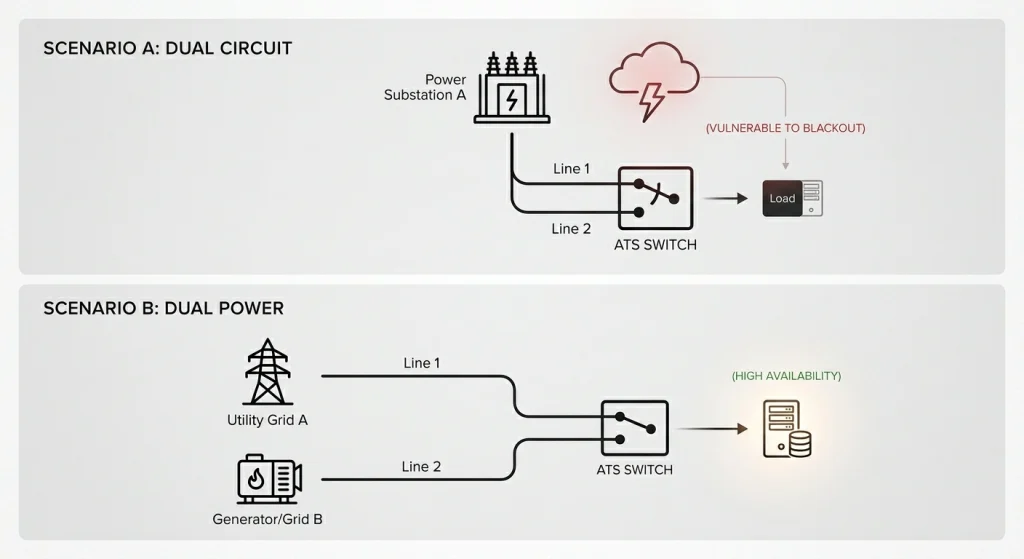
Dual Power Supply vs Dual Circuit: What is the difference?
Home Dual Power vs Dual Circuit ATS: Clear Engineering Differences If you ask…
- Product Knowledge, 未分类
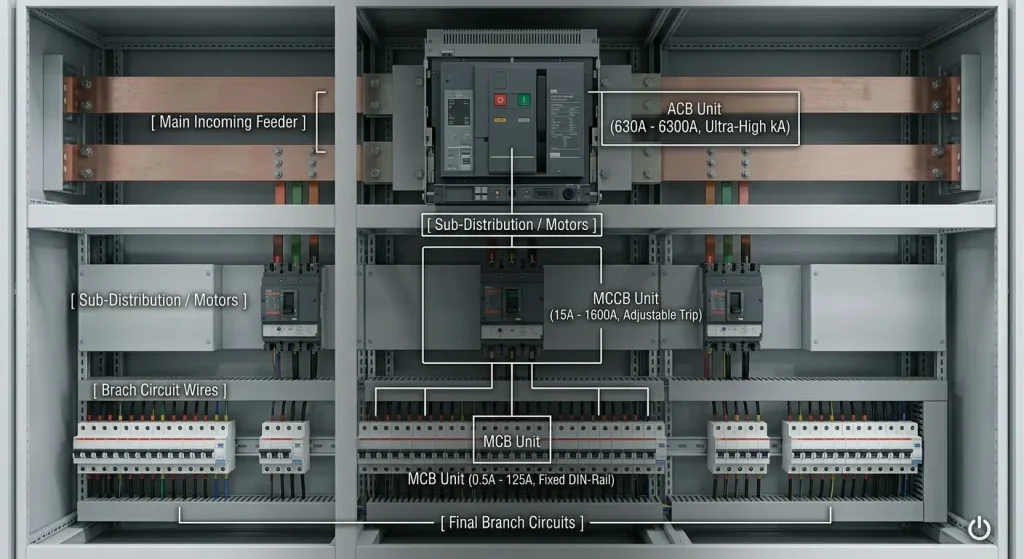
Difference Between MCB MCCB and ACB: Complete Selection Guide
Home Difference Between MCB MCCB and ACB: Complete Selection Guide Navigating the difference…
- Product Knowledge
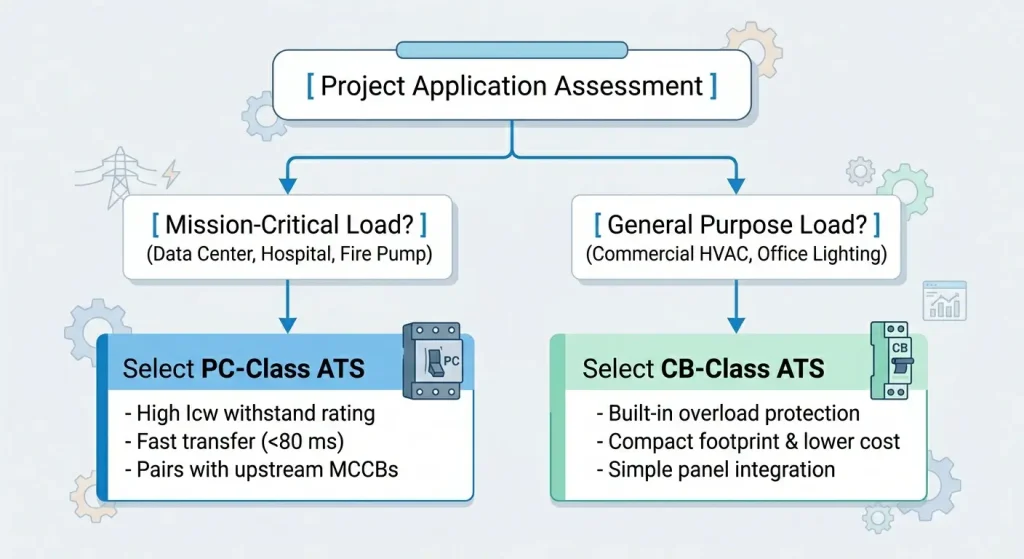
PC Class vs CB Class ATS: How to Choose the Right Automatic Transfer Switch
Home PC Class vs CB Class Automatic Transfer Switch: How to Choose the…