
- Home
- Difference Between MCB MCCB and ACB: Complete Selection Guide
Difference Between MCB MCCB and ACB: Complete Selection Guide
Navigating the difference between MCB MCCB and ACB units is one of the most fundamental tasks for electrical engineers, panel builders, and industrial component buyers. In any modern low-voltage power distribution system, circuit breakers serve as the primary line of defense against electrical overloads, thermal degradation, and dangerous short circuits.
However, using a miniature circuit breaker (MCB) where a molded case circuit breaker (MCCB) is required—or misconfiguring an air circuit breaker (ACB) at the main incoming feeder—can lead to severe equipment damage, uncoordinated tripping, and regulatory non-compliance. This guide breaks down the technical hierarchy, operational parameters, and real-world selection logic for all three circuit breaker types.
The 3 Pillars of Low-Voltage Protection
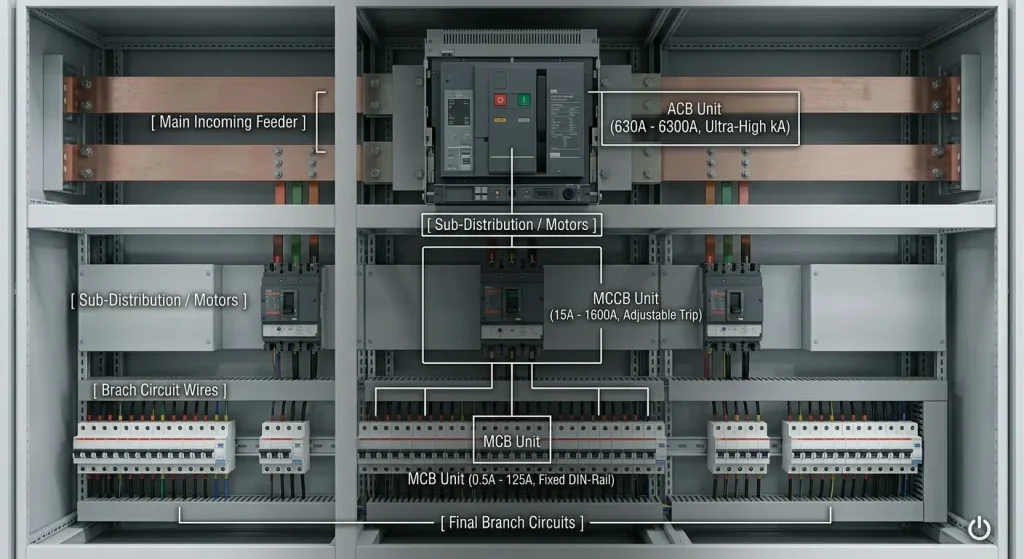
Rather than treating these devices as isolated components, understanding the difference between MCB MCCB and ACB setup is best achieved by viewing a low-voltage power network as a three-tier protection pyramid:
1. Air Circuit Breakers (ACB): Safeguarding Main Incomers
Positioned at the top of the distribution network, ACBs handle main incoming feeders directly downstream of power transformers. Engineered for high current capacities (typically from 630A up to 6300A) and extreme short-circuit breaking ratings (often 50kA to 150kA), ACBs use open-air arc extinguishing chutes and intelligent microprocessor trip units (micro-logic controllers) to provide comprehensive system diagnostics and selective coordination.
2. Molded Case Circuit Breakers (MCCB): Backbone Feeder Protection
MCCBs form the backbone of industrial and commercial power distribution, managing branch feeders, heavy machinery, and motor control centers (MCC). With current ratings spanning 15A to 1600A, MCCBs feature a heavy-duty glass-filled polyester housing that insulates internal contacts. Most industrial MCCBs incorporate adjustable thermal-magnetic or electronic trip units, allowing panel builders to fine-tune pickup currents and time delays.
3. Miniature Circuit Breakers (MCB): Final Branch Protection
Located at the final branch circuits of control cabinets and local distribution boards, MCBs protect lighting lines, small appliances, and sensitive control circuits. Designed for modular 35mm DIN-rail mounting, MCBs cover lower current ranges (0.5A to 125A) with fixed trip characteristics (such as B, C, or D curves) and breaking capacities typically ranging between 4.5kA and 10kA.
Difference Between MCB MCCB and ACB: The Master Comparison Matrix
Understanding the difference between MCB MCCB and ACB models requires comparing physical construction, electrical ratings, and system roles:
| Engineering Parameter | MCB (Miniature) | MCCB (Molded Case) | ACB (Air Circuit Breaker) |
|---|---|---|---|
| Rated Current Range (In) | 1A to 125A | 10A to 1600A | 630A to 6300A |
| Breaking Capacity (Icu) | 4.5kA to 10kA | 10kA to 100kA+ | 50kA to 150kA+ |
| Trip Unit Technology | Fixed thermal-magnetic | Adjustable thermal or electronic | Advanced microprocessor / Micro-logic |
| Mounting Architecture | 35mm DIN-rail snap-on | Panel chassis / Base plate mount | Fixed or Draw-out (Rackable) frame |
| Primary System Role | Terminal circuit protection | Feeder & motor branch protection | Main low-voltage transformer incomer |
Common Misconceptions to Avoid
Misconception 1: “A higher amp rating is always better.” Oversizing a breaker prevents it from tripping during actual overload conditions, creating a fire hazard in downstream cables.
Misconception 2: “MCBs and MCCBs use the same trip mechanism.” While both protect against overcurrents, MCBs have fixed factory-calibrated trip curves, whereas industrial MCCBs allow field adjustments for precise coordination.
For deeper insights into international safety compliance, read our compliance guide on IEC 60947 Circuit Breaker Standard: Complete Compliance Guide.
Real-World Case Study: Designing a 500kW Industrial Factory Panel
To see how the practical difference between MCB MCCB and ACB units impacts daily engineering design, consider a typical 500kW industrial manufacturing plant supplied by a 400V low-voltage transformer:
At the Main Low-Voltage Switchboard (MLVS): A 1000A 3-Pole Air Circuit Breaker (ACB) with a microprocessor trip unit is installed as the main incomer. It monitors total plant load, provides short-time delay protection ($I_{sd}$), and communicates with the factory automation SCADA system via RS485 Modbus.
At the Motor Control Center (MCC): Several 250A and 400A Molded Case Circuit Breakers (MCCBs) with adjustable magnetic trip settings protect individual CNC production lines and heavy induction motors, ensuring high inrush motor currents do not trigger nuisance tripping.
At the Local Control Boxes: Dozens of 10A to 32A Miniature Circuit Breakers (MCBs) on DIN rails protect individual PLC controllers, sensor power supplies, and LED factory lighting circuits.
Key Quality Factors for OEM Component Sourcing
When analyzing the manufacturing difference between MCB MCCB and ACB lines from factory suppliers, electrical importers and panel builders should verify three crucial build metrics:
Arc Chute Construction: High-quality breakers feature arc chutes made with corrosion-resistant de-ionizing steel plates that cool and extinguish electric arcs within milliseconds during fault interruption.
Silver Alloy Contact Thickness: Contact tips composed of silver-tin-oxide ($\text{AgSnO}_2$) offer superior welding resistance and low contact resistance compared to lower-grade copper alloys.
Compliance Certification: Ensure all units hold valid third-party test certifications under IEC 60947-2 for industrial applications and CE marks for European market import. Review testing criteria on the official
Community & Technical FAQs
Q1: What happens if I install an MCB instead of an MCCB for a heavy industrial motor?
An MCB installed on a heavy industrial motor line will likely experience frequent nuisance tripping due to high motor starting inrush currents (which can reach 6 to 8 times the rated current). Furthermore, if a severe short circuit occurs, the motor circuit fault current may exceed the MCB’s maximum breaking capacity (typically 6kA or 10kA), potentially causing the small breaker to weld shut or rupture.
Q2: Why do ACBs use air as the arc extinguishing medium instead of vacuum or oil?
In low-voltage applications (up to 1000V AC), atmospheric air provides excellent insulating properties when combined with specially designed splitter plates inside arc chutes. Air-insulated construction allows easy inspection of main contacts and mechanical linkages without the complex sealing hardware required for vacuum or SF6 medium-voltage equipment.
Q3: Can an MCCB offer the same breaking capacity as an ACB?
High-tier electronic MCCBs can achieve impressive short-circuit breaking capacities (up to 100kA at 415V), matching some compact ACBs. However, ACBs still excel in short-time withstand current ($I_{cw}$) capability, allowing them to delay tripping for up to 1 second to let downstream MCCBs clear localized faults first.
Q4: What is the main structural benefit of a draw-out (rackable) ACB frame?
A draw-out ACB can be physically racked out from its enclosure chassis using a hand crank while the main panel busbars remain energized. This allows maintenance engineers to inspect, service, or replace main contacts safely without shutting down the entire factory power system.
Final Engineering Recommendations
Understanding the structural and functional difference between MCB MCCB and ACB models enables engineering teams to build safe, cost-effective, and fully coordinated electrical distribution systems.
Need High-Performance Circuit Breakers for Your OEM Projects?
Zhejiang Manfu Power Technology Co., Ltd. manufactures certified MCBs, MCCBs, and ACBs engineered for global electrical distributors, panel builders, and project contractors.
Explore Product Lines: Check out our full range of Industrial Circuit Breakers.
Technical Support: Contact our engineering team for CAD schematics, technical data sheets, and direct factory-gate pricing.
Get In Touch
Partner with a Trusted Electrical Manufacturer
Looking for high-reliability electrical components, OEM/ODM solutions, or custom bulk pricing? Our engineering team is ready to support your project requirements.
Direct Call
+86 (566) 456-7890
Email Inquiry
support@zjmnfu.com
Request a Fast & Free Quote
Fill out the form below and our sales team will respond with product specifications and pricing within 24 hours.
Other Related Blogs
- Product Knowledge, 未分类
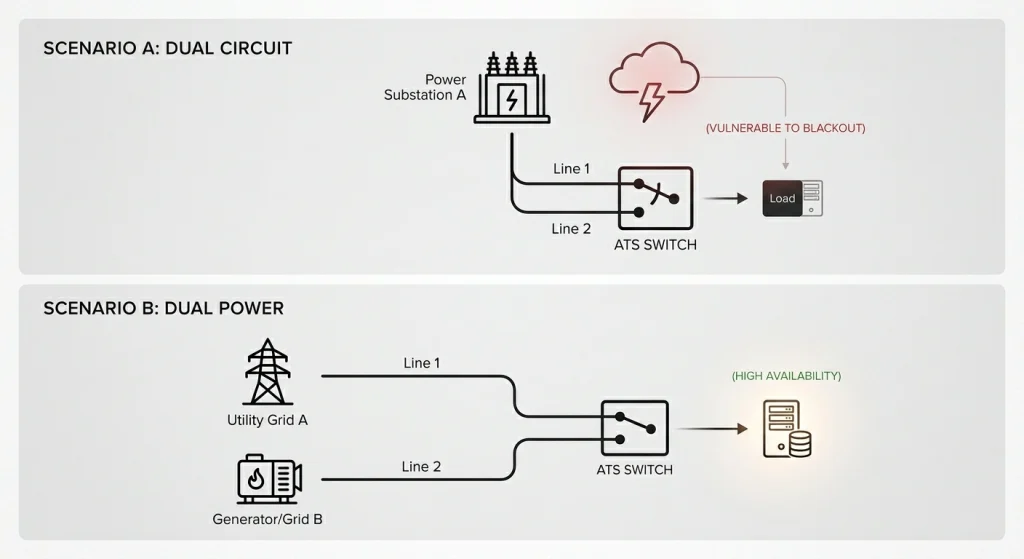
Dual Power Supply vs Dual Circuit: What is the difference?
Home Dual Power vs Dual Circuit ATS: Clear Engineering Differences If you ask…

- Product Knowledge, 未分类
Industrial Circuit Breaker Tripping Causes: Fixes & Prevention Guide
Home Industrial Circuit Breaker Tripping Causes: Field Troubleshooting & Fixes Understanding industrial circuit…
- Product Knowledge
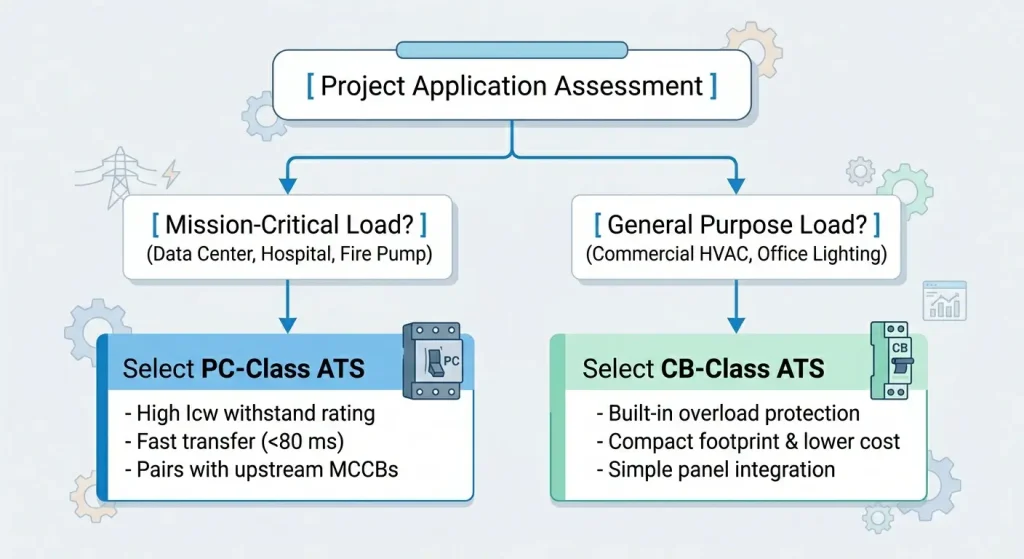
PC Class vs CB Class ATS: How to Choose the Right Automatic Transfer Switch
Home PC Class vs CB Class Automatic Transfer Switch: How to Choose the…